
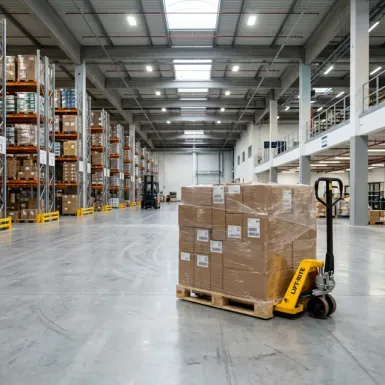
Heavy pallets demand a system, not guesswork
Moving a loaded pallet across a warehouse can look routine, but the risks rise quickly when weight, blind corners, uneven floors, and foot traffic come together. Most incidents happen when operators rush the setup, move a damaged pallet, pull instead of push, or travel without a clear route. A safer process starts before the forks even go under the load.
This guide brings together practical warehouse training habits and the visual cues shown in the reference video so operators can handle heavy pallets with more control, less strain, and better awareness of the people working nearby.
Watch the training video first
Use the video below as a quick visual refresher before reading the written checklist. It reinforces safe body position, fork entry, and the importance of controlled movement when handling a heavier load.
1. Start with the truck, the pallet, and the load condition
Before moving anything, inspect the pallet truck and the load together. A sound truck cannot compensate for a broken pallet, and a stable pallet can still become dangerous if the wheels or hydraulics are not performing correctly.
- Check the pallet truck: Confirm the forks are straight, the handle responds smoothly, the hydraulics lift and lower cleanly, and the wheels are free of debris or flat spots.
- Check the pallet: Look for split deck boards, protruding nails, missing blocks, or visible distortion that could cause collapse during travel.
- Check the load: Make sure cartons are stacked evenly, shrink wrap is secure, and nothing is leaning, overhanging, or likely to slide when momentum changes.
- Check the weight match: If the load looks questionable for a manual truck or the route includes ramps, dock plates, or tight turns, pause and use more suitable equipment.
2. Insert the forks fully and lift only enough to travel
One of the safest habits in pallet handling is to keep the load as low and as centered as possible. That means lining the forks up squarely, inserting them fully, and raising the pallet just high enough to clear the floor.
- Approach straight: Align the forks with the pallet openings so you do not clip a board or twist the load on entry.
- Center the truck: Keep the weight balanced across both forks rather than carrying it off-center.
- Push in fully: Partial fork entry concentrates weight in the wrong area and increases tipping risk.
- Lift minimally: Raise the pallet only enough for safe rolling clearance. Excess lift raises the center of gravity and makes a heavy pallet harder to control.
Figure 1: Keep both hands on the tiller, maintain a stable stance, and move the load at a controlled walking pace.
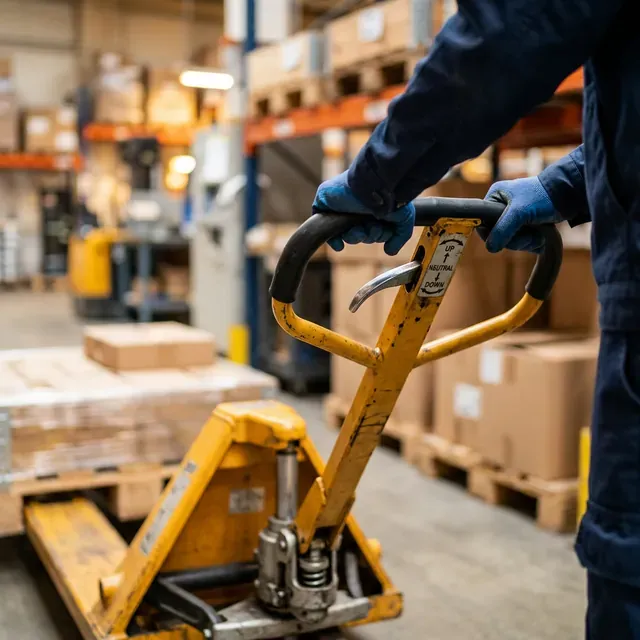
Good technique should feel deliberate rather than fast. The operator should be able to stop, correct direction, and maintain a clear walking path at every point in the move.
3. Push when possible and keep your body in a strong position
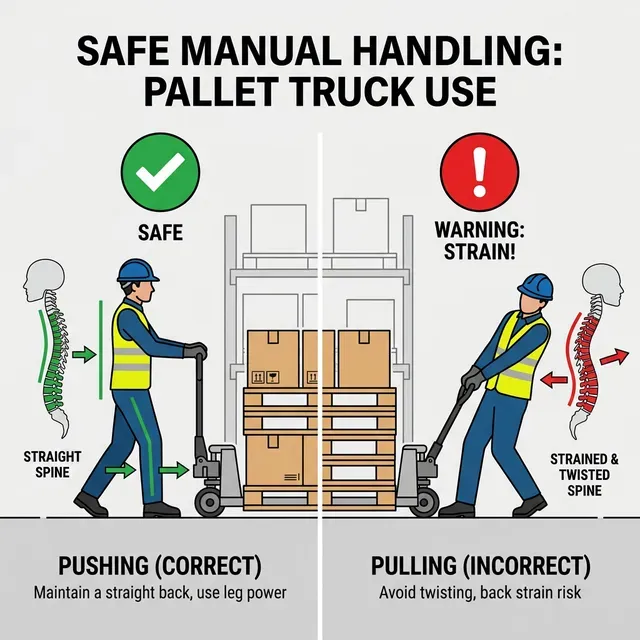
For most flat warehouse travel, pushing is safer than pulling because it lets you use your legs, maintain a more neutral spine, and keep the load in front of your line of sight. Pulling a heavy pallet often introduces twisting through the shoulders and lower back, especially when starting from rest.
- Use both hands on the handle: Keep a firm, balanced grip and avoid one-handed steering with a heavy load.
- Walk at a controlled pace: Sudden acceleration makes the load harder to stop and easier to sway.
- Avoid sharp turns: Take wide, predictable corners so the pallet does not catch racking, posts, or door frames.
- Keep feet clear: Safety footwear matters because foot injuries are common when heavy pallets roll unexpectedly or lower into the wrong place.
4. Plan the route before the load starts moving
Heavy pallet movement becomes much safer when the route is decided in advance. Operators should know where they are going, what hazards are on the floor, and where visibility is restricted before they start rolling.
Figure 2: Before entering shared aisles, slow down, verify the path is clear, and keep the load in a position you can control without twisting.
- Clear the route: Remove loose wrap, broken pallets, stray cartons, and other trip or wheel hazards.
- Manage blind spots: Slow down at corners, intersections, and doorways, and give a verbal warning when needed.
- Protect pedestrian space: Never assume others can see or hear the moving load. Make eye contact when crossing shared aisles.
- Check floor conditions: Wet patches, damaged concrete, dock plates, thresholds, and expansion joints can all destabilize a heavy pallet truck.
5. Treat slopes, docks, and trailer transitions as higher-risk zones
Ramps and loading areas change the hazard level immediately. Even a well-balanced pallet can surge, drift, or become difficult to restrain if gravity begins to assist the movement.
- Reduce speed before the transition: Enter dock plates and ramps slowly and squarely.
- Check support surfaces: Make sure dock boards, lift tables, trailers, and tail lifts are rated for the combined weight of the load and truck.
- Never improvise on unstable ground: If the slope, floor condition, or trailer stability is in doubt, stop the task and escalate it.
- Use extra help when needed: A spotter or powered equipment is often the safer choice for long distances, gradients, or unusually heavy pallets.
6. Communicate clearly and wear the right PPE
Safe pallet handling is not just an operator skill. It is also a coordination habit. Warehouses are shared spaces, so good communication lowers the chance of surprise movements and last-second evasive actions.
- Signal your move: Let nearby coworkers know when you are entering an aisle, backing out of a bay, or setting a pallet down.
- Use PPE consistently: Steel-toe footwear, high-visibility clothing, and gloves suited to the task improve protection and control.
- Set down carefully: Lower the pallet only when feet and hands are clear and the destination surface is stable and level.
- Report defects immediately: A leaking jack, damaged wheel, or broken pallet should be removed from use instead of worked around.
Quick warehouse checklist for heavy pallet moves
| Checkpoint | Safe practice |
|---|---|
| Truck condition | Test wheels, forks, and lift/lower function before use. |
| Load stability | Reject leaning, damaged, or badly wrapped loads. |
| Travel height | Keep the pallet low, with just enough floor clearance to move. |
| Operator movement | Push at a controlled pace and avoid twisting or sudden turns. |
| Route safety | Check corners, slopes, floor condition, and pedestrian traffic first. |
Final takeaway
If you want to move heavy pallets safely in a warehouse, focus on preparation, low lift height, controlled pushing, clear routes, and steady communication. The safest operators are rarely the fastest starters. They are the people who build a predictable move from the first inspection to the final set-down.